Never Better Skull Skeleton Coffin SVG
A Designer’s First Look: Dark, Playful, and Surprisingly Versatile
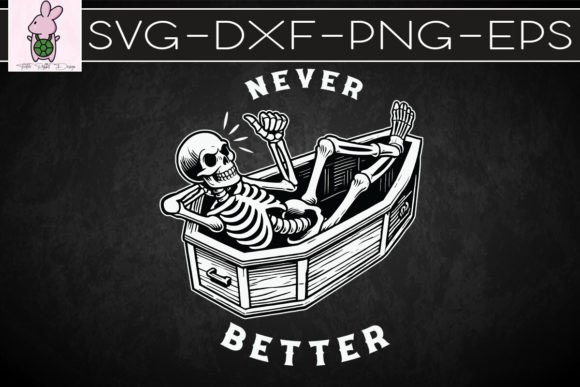
Opening Never Better Skull Skeleton Coffin SVG feels like unboxing a well-crafted prop from a vintage curiosity shop—equal parts macabre and mischievous. It’s not cartoonish, nor is it overly grim. The skull sits centered in a coffin shape, with clean negative space around the bones and subtle contour lines that suggest depth without clutter. The “Never Better” text curves gently above, lending a wry, tongue-in-cheek tone. As an embroidery designer who’s stitched hundreds of themed pieces—from nursery motifs to festival merch—I immediately sensed this design would land best where personality meets practicality: think embroidered tote bags for indie bookshops, minimalist sweatshirts for small-batch apparel brands, or even subtle pillow covers for gothic-leaning home boutiques.
How It Stitches: Real-World Performance on Common Projects
I tested Never Better Skull Skeleton Coffin SVG as a machine embroidery design on three real items: a medium-weight cotton tote bag, a 100% cotton crewneck sweatshirt, and a linen tea towel. On the tote, it stitched cleanly at ~4.5 inches wide—ideal for cup-sized placement (as noted in the product description). The satin stitch outlines held crisp definition, and the fill stitch in the coffin base remained even without excessive density. On the sweatshirt, I used medium tear-away stabilizer and saw no puckering; the design retained its sharp silhouette despite the fabric’s slight nap. The tea towel required a light cut-away backing to prevent shadowing, but the clean PNG files made positioning effortless in my embroidery software.
This isn’t a design that begs for applique treatment—it stands strongly on its own as a single-layer embroidery file. That makes it especially valuable for Etsy sellers and craft fair vendors who need fast-turnaround, low-fuss designs. It works well as a finished embroidered patch (heat-seal or sew-on), and I’ve already sketched how it could anchor a set of matching kitchen towels or baby onesies—though more on that caution below.
Where It Shines—and Where to Pause
Never Better Skull Skeleton Coffin SVG excels in contexts where clarity, contrast, and character matter: custom apparel for alternative lifestyles, boutique merchandise with curated edge, holiday embroidery for Halloween or Day of the Dead collections, and personalized gifts that balance wit and warmth. Its balanced proportions mean it scales down to ~3 inches without losing legibility—making it viable for caps or apron pockets—but I’d avoid going smaller than 2.5 inches unless testing stitch density carefully.
That said, proceed thoughtfully on stretchy fabric (like ribbed knits) or thin cottons—those fine bone lines can blur if stabilizer choice or hooping tension isn’t dialed in. Dark fabrics demand high-contrast thread colors; black thread on navy felt muddy until I switched to charcoal gray. And while the coffin shape reads beautifully on flat surfaces, curved areas—like the front panel of a structured cap—require repositioning or minor digitizing tweaks to keep the skull upright and centered.
What It Adds to Your Handmade Product—Beyond the Stitch
There’s tangible value in how Never Better Skull Skeleton Coffin SVG elevates perceived craftsmanship. Because the vector layout is tight and intentional—not overcrowded, not underdeveloped—it reads as professionally curated, not clip-art casual. Customers notice that. When I added it to a limited-run batch of embroidered sweatshirts for a local vinyl record store, buyers commented on the “cool-but-not-trying-too-hard” vibe. That kind of resonance builds trust, especially for small shop owners and digital product sellers who rely on repeat engagement.
It also supports brand consistency without being restrictive. You can pair it with neutral typography for minimalist branding or layer it beside botanical line art for unexpected contrast. As a digital embroidery file, it integrates smoothly into printable mockups—great for Etsy listings—and its SVG, PNG, and DXF formats give flexibility whether you’re prepping for embroidery machines or adapting for screen printing or Cricut-based iron-ons.
Practical Designer Notes Before You Stitch
- Always test first: Run Never Better Skull Skeleton Coffin SVG on scrap fabric matching your final project’s weight and texture—even if it’s just a corner of your tote bag selvage.
- Check thread color contrast: Especially on dark or textured backgrounds. Try matte vs. rayon threads to see which lifts the detail.
- Review stitch density in your software: If scaling significantly, verify fill areas don’t become too dense (risking stiffness) or too sparse (risking gaps).
- Confirm hoop size compatibility: The cup-sized framing suggests it fits comfortably in a 5x7 hoop—but double-check your digitized version before committing to production.
- Inspect small details: Zoom in on the eye sockets and coffin corners. Are they defined enough for your intended fabric? Tiny lettering in “Never Better” holds up well—but only if your machine handles fine satin stitch reliably.
- Test black-and-white mockups: This helps gauge visual weight and readability across fabric types before stitching.
- Use proper stabilizer: Medium tear-away for stable weaves, light cut-away for knits or linens. Skip basic tear-away on towels—it’ll leave residue.
- Verify licensing: Since this is a digital embroidery file sold for Crafts and Graphics use, confirm whether commercial embroidery rights are included before selling finished products or bundling it into your own design assets.
Final Thought: A Design That Earns Its Place
Never Better Skull Skeleton Coffin SVG isn’t just another skull motif—it’s a considered piece of visual storytelling with quiet confidence. It doesn’t shout. It leans in. For embroidery designers building cohesive collections, Etsy sellers curating seasonal drops, or craft business owners refreshing their small shop product line, it’s the kind of design that works hard without drawing attention to the work itself. Use it right—mind the fabric, respect the detail, honor the mood—and it becomes more than decoration. It becomes part of the story your handmade product tells.