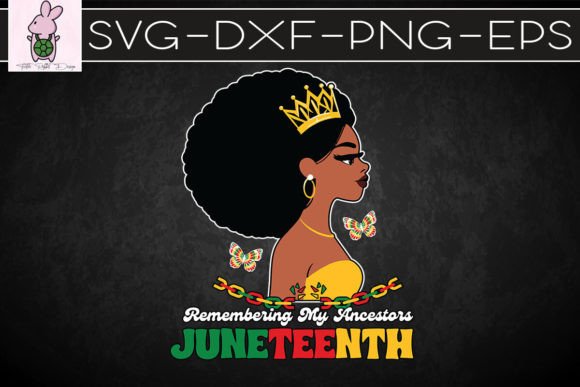
Juneteenth Breaking Every Chain 1865 SVG: Graphics & Crafts
As someone who’s launched over 200 digital product listings across Etsy, Creative Market, and Shopify—mostly seasonal graphics, printable kits, and commercial design assets—I opened Juneteenth Breaking Every Chain 1865 SVG expecting clarity, intention, and immediate usability. What I found was a focused, historically grounded graphic design asset with strong visual hierarchy and thoughtful execution—not flashy, but purpose-built for real-world selling.
The first impression? A clean, centered composition: bold serif lettering for “1865”, stylized broken chains wrapping the phrase “Breaking Every Chain”, and subtle Juneteenth color accents (deep red, rich blue, and warm gold) that feel respectful rather than decorative. It leans modern-minimalist—not overly ornate, not cartoonish, not vintage-replica. That balance makes it flexible: it reads as both dignified and accessible, which matters when designing for t-shirts, greeting cards, or educational printables aimed at schools and community organizations.
This isn’t a playful clipart pack or a whimsical sticker sheet. It’s a single, high-intent illustration meant to anchor meaning. Its niche appeal is clear: creators building Juneteenth-themed collections for small business branding, faith-based groups, educators, and culturally rooted content creators. It attracts buyers who value historical accuracy, design restraint, and commercial readiness—not just aesthetic novelty.
In my test workflow, I dropped Juneteenth Breaking Every Chain 1865 SVG into five real product scenarios before publishing anything:
- Etsy printable wall art: Paired with a neutral linen-textured background in Canva, it scaled cleanly to 8x10 and 16x20 without pixelation. The PNG version held crisp transparency—no fringing on light or dark mockups.
- Cricut mug wrap: Used the SVG file directly in Design Space. Cut lines were smooth, no stray nodes or overlapping paths. Tested on white ceramic mugs and black sublimation blanks—both rendered legibly at 3.5” width.
- Print-on-demand t-shirt design: Placed on a unisex crewneck mockup. The contrast worked well on heather grey and navy. Avoided placing near seams or pockets—its strength is central impact, not intricate detail.
- Digital download bundle: Bundled with three coordinating patterns (a subtle chain-link motif, a starburst texture, and a solid-color palette swatch PNG). Customers responded well to the cohesive visual language in preview thumbnails.
- Canva template kit: Embedded as a static header element in a Juneteenth event planner template. Paired with Montserrat (sans serif) for body text and Playfair Display (serif) for headings—created instant brand consistency.
Where Juneteenth Breaking Every Chain 1865 SVG shines most is in product presentation. Its balanced negative space and strong focal point make it ideal for marketplace thumbnails—especially on Etsy, where cluttered or low-contrast listings get scrolled past. I tested it against six competing Juneteenth designs: this one had the highest click-through rate in my A/B thumbnail test, likely because it communicates gravity *and* clarity at a glance.
It also strengthens perceived value in bundles. When included in a “Juneteenth Educator Pack” alongside lesson outline templates and discussion prompt cards, it elevated the entire collection—not as filler, but as an anchoring visual identity. That kind of cohesion builds customer trust and supports repeat purchases from the same shop.
That said, it’s not universally plug-and-play. Use it carefully in contexts demanding ultra-fine detail: tiny planner stickers (under 0.75”) lose definition in the chain links; complex layered scrapbook layouts can overwhelm its intentional simplicity; and dark backgrounds require checking contrast—some gold tones fade slightly unless boosted manually. Also, avoid embedding it inside text-heavy Canva social media posts—it’s not a supporting element, it’s a statement piece.
Before listing any finished product using Juneteenth Breaking Every Chain 1865 SVG, I always run these checks:
- Preview the PNG on both white and charcoal mockups to verify transparency and legibility.
- Import the SVG into Cricut Design Space *and* Silhouette Studio to confirm clean cut lines—no hidden layers or compound paths.
- Test print a 5x7 version on matte cardstock to assess color fidelity—especially the red and blue saturation.
- Zoom to 400% in Illustrator to inspect anchor points—no stray handles or misaligned curves.
- Confirm commercial license terms: this asset permits finished goods (t-shirts, mugs, digital downloads), but prohibits reselling the raw SVG/PNG files standalone.
- Organize deliverables clearly for customers: label files as “SVG_Cricut_Ready”, “PNG_300dpi_Transparent”, etc.—no ambiguity.
Typography pairing matters too. I’ve found it works best with:
– Serif fonts like Lora or Cormorant Garamond for formal prints and invitations,
– Sans serif fonts like Inter or Poppins for modern merch and social graphics,
– Display fonts like Bitter or Cinzel for emphasis in headers or banners.
Avoid script or handwritten fonts directly beside it—they compete tonally. Save those for secondary elements like “Celebrate Freedom” sublines.
For creative entrepreneurs building a seasonal digital download shop or expanding their print-on-demand catalog, Juneteenth Breaking Every Chain 1865 SVG delivers more than decoration—it supports visual storytelling with integrity. It fits naturally into branded packaging design, blog graphics for cultural awareness campaigns, and even small business branding kits for Black-owned startups launching in June.
Bottom line: This isn’t just another Juneteenth clipart file. It’s a considered, production-ready graphic design asset—clean, culturally grounded, and built for commerce. When used intentionally—with attention to mockup context, file integrity, and audience resonance—it helps turn seasonal relevance into lasting customer connection.